
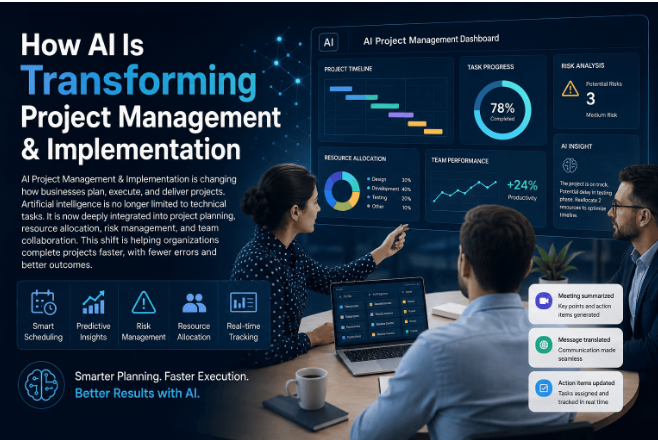
AI Project Management & Implementation is changing how businesses plan, execute, and deliver projects. Artificial intelligence is no longer limited to technical tasks. It is now deeply integrated into project planning, resource allocation, risk management, and team collaboration. This shift is helping organizations complete projects faster, with fewer errors and better outcomes.
Traditional project management relied heavily on manual tracking, static planning tools, and human judgment. While effective in the past, these methods struggle to keep up with modern business complexity. AI introduces real-time intelligence into every stage of project execution, making workflows more adaptive and data-driven.
The Shift from Traditional to AI-Powered Project Management
In conventional project management, teams often depend on spreadsheets, manual updates, and periodic reporting. This creates delays and increases the risk of miscommunication.
AI changes this model by introducing AI business automation and predictive insights. Instead of reacting to problems, teams can now anticipate them before they occur.
AI-powered systems help with:
- Automated task scheduling
- Predictive deadline management
- Real-time project tracking
- Intelligent resource allocation
- Risk identification and mitigation
This transformation allows project managers to focus less on administrative work and more on strategic decision-making.
Why AI Is Becoming Essential in Project Execution
Modern projects are more complex than ever. They involve distributed teams, tight deadlines, and rapidly changing requirements. AI helps manage this complexity by processing large amounts of data and providing actionable insights.
AI in project management improves:
- Planning accuracy through data analysis
- Productivity by reducing manual workload
- Communication with automated updates and alerts
- Decision-making using predictive analytics
- Overall project visibility across teams
This is why AI project management tools are becoming essential for businesses that want to stay competitive in fast-moving industries.
Key Areas Where AI Is Making an Impact
AI is not limited to one part of project management. It is influencing multiple stages of the project lifecycle.
1. Project Planning and Forecasting
AI tools analyze historical data to predict timelines, budgets, and resource needs more accurately than traditional methods.
2. Task Automation and Workflow Optimization
Routine tasks like assigning work, sending reminders, and updating progress are now automated, reducing administrative overhead.
3. Risk Management
AI identifies potential risks early by analyzing patterns and flagging anomalies in project data.
4. Resource Allocation
AI ensures that the right people are assigned to the right tasks based on skill, availability, and workload.
5. Performance Tracking
Real-time dashboards powered by AI provide continuous insights into project progress and team performance.
The Role of AI in Improving Team Collaboration
Collaboration is a critical part of successful project delivery. AI enhances collaboration by ensuring that communication is seamless and information is always up to date.
AI-powered tools can:
- Summarize meetings automatically
- Translate messages across languages
- Highlight important updates
- Track action items in real time
- Reduce communication gaps between teams
This leads to smoother coordination, especially in remote and hybrid work environments.
AI Tools, Real-World Use Cases, and Agile Integration
AI Project Management & Implementation is not just a concept. It is already being used in real business environments to streamline workflows, improve delivery speed, and reduce project risks. The combination of AI tools and modern project frameworks like Agile is creating a new standard for how teams operate.
AI Tools Changing Project Management
A growing number of AI-powered tools are helping project managers move from manual coordination to intelligent automation. These tools analyze project data, suggest improvements, and even take over repetitive tasks.
Some key capabilities include:
- Smart task prioritization based on deadlines and workload
- Automated progress tracking and reporting
- Predictive analytics for project delays
- Intelligent workload balancing across teams
- AI-generated insights for better decision-making
These features allow project managers to focus more on leadership and strategy rather than administrative tracking.
How AI Improves Agile and Scrum Workflows
Agile methodology is widely used in modern software and product development. When combined with AI, Agile becomes even more efficient and data-driven.
AI enhances Agile practices by:
- Predicting sprint completion rates based on historical performance
- Identifying bottlenecks in workflows early
- Improving backlog prioritization using data insights
- Automating sprint reporting and retrospectives
- Enhancing team velocity tracking with real-time analytics
This integration helps teams deliver faster while maintaining quality and flexibility.
Real-World Use Cases of AI in Project Management
AI is already making a measurable impact across industries. Businesses are using AI-driven project management systems in different ways depending on their goals and complexity.
1. Software Development Projects
AI helps development teams track bugs, manage sprints, and automate testing workflows. It also predicts potential delays before they impact release schedules.
2. Marketing Campaign Management
Marketing teams use AI to plan campaigns, allocate budgets, and track performance across multiple channels in real time.
3. Construction and Infrastructure Projects
AI assists in scheduling, resource planning, and risk detection by analyzing environmental and operational data.
4. Product Development
AI helps teams forecast demand, manage timelines, and coordinate cross-functional workflows between design, engineering, and marketing.
5. Enterprise Operations
Large organizations use AI to manage complex internal workflows, compliance processes, and multi-team coordination across global locations.
The Rise of Predictive Project Management
One of the most powerful shifts brought by AI is predictive project management. Instead of simply tracking what is happening, AI now predicts what will happen next.
This includes:
- Forecasting project delays before they occur
- Identifying resource shortages in advance
- Predicting budget overruns
- Highlighting high-risk tasks
- Suggesting corrective actions automatically
Predictive intelligence helps businesses move from reactive management to proactive execution.
Why AI and Agile Together Work So Well
Agile focuses on flexibility and iteration, while AI focuses on data-driven decision-making. When combined, they create a powerful system that balances speed with accuracy.
This combination allows teams to:
- Adapt quickly to changing requirements
- Reduce uncertainty in planning
- Improve sprint outcomes with better insights
- Continuously optimize workflows
- Deliver higher-quality results in less time
Implementation Strategies, Challenges, and the Future of AI Project Management
AI Project Management & Implementation is rapidly becoming a core part of modern business operations. However, successful adoption is not just about using tools. It requires the right strategy, mindset, and long-term planning.
Organizations that implement AI effectively are not only improving efficiency but also building stronger, more adaptive project ecosystems.
How Businesses Can Implement AI in Project Management
Adopting AI in project management should be a structured process rather than a sudden shift. Companies need to integrate AI gradually into existing workflows while ensuring teams are properly trained using project management tools for small teams.
A practical implementation approach includes:
- Identifying repetitive and time-consuming tasks for automation
- Integrating AI tools with existing project management platforms
- Training teams to interpret AI-driven insights correctly
- Starting with pilot projects before full-scale adoption
- Continuously evaluating performance and optimizing workflows
This step-by-step approach ensures smoother adoption and reduces resistance to change.
Challenges in AI Project Management Adoption
While AI offers significant benefits, businesses also face challenges during implementation. Understanding these challenges is essential for long-term success.
Some common issues include:
- Data quality problems: AI systems depend on accurate and structured data
- Integration complexity: Connecting AI tools with legacy systems can be difficult
- Skill gaps: Teams may lack experience in AI-driven decision-making
- Over-reliance on automation: Excessive dependence can reduce human oversight
- Change resistance: Employees may be hesitant to adopt new workflows
Addressing these challenges requires proper planning, training, and continuous support.
The Future of AI in Project Management
The future of AI Project Management & Implementation is moving toward fully autonomous and self-optimizing systems. Instead of simply assisting project managers, AI will take a more active role in execution and decision-making.
Future developments may include:
- Fully automated project scheduling and execution systems
- AI-driven virtual project managers handling routine decisions
- Real-time adaptive project plans that change dynamically
- Deep integration with enterprise systems and cloud platforms
- Advanced predictive models for near-perfect project forecasting
These advancements will redefine how organizations plan and deliver work across industries.
Human + AI Collaboration Will Define Success
Even with advanced automation, human input will remain essential. The most successful organizations will be those that combine human creativity with AI intelligence.
Project managers will evolve into strategic leaders who:
- Guide AI systems with business context
- Focus on high-level decision-making
- Manage stakeholder relationships
- Ensure ethical and responsible AI use
- Interpret insights rather than manually collecting data
This balance is critical for long-term success in AI-driven environments.
Final Thoughts
AI Project Management & Implementation is not just improving how projects are managed. It is fundamentally changing how work is structured, executed, and optimized. Businesses that adopt AI early will benefit from faster delivery, better resource utilization, and improved project outcomes.
However, success depends on balance. Companies that understand this balance will lead the next wave of digital transformation.
FAQs
1. What is AI in project management?
AI in project management refers to the use of artificial intelligence to automate planning, tracking, forecasting, and decision-making in projects.
2. How does AI improve project execution?
It improves execution by automating tasks, predicting risks, optimizing resources, and providing real-time insights.
3. Can AI replace project managers?
No. AI supports project managers but cannot replace human leadership, creativity, and strategic thinking.
4. What industries benefit most from AI project management?
Software development, marketing, construction, healthcare, and enterprise operations benefit significantly.
5. Is AI project management suitable for small businesses?
Yes. Small businesses can use AI tools to improve efficiency, reduce costs, and scale operations effectively.